
It’s 5:00am on a Wednesday in the first week of May, and three teams of Arid Recovery ecologists, Team Kowari researchers and volunteers are climbing into work vehicles – wearing beanies and carrying travel mugs of hot drinks. Datasheets, calico bags, wool, duct tape, dog biscuits and hessian sacks are strewn around the utes. It’s the middle of the annual kowari survey at Arid Recovery – five nights of trapping across three paddocks of the reserve.
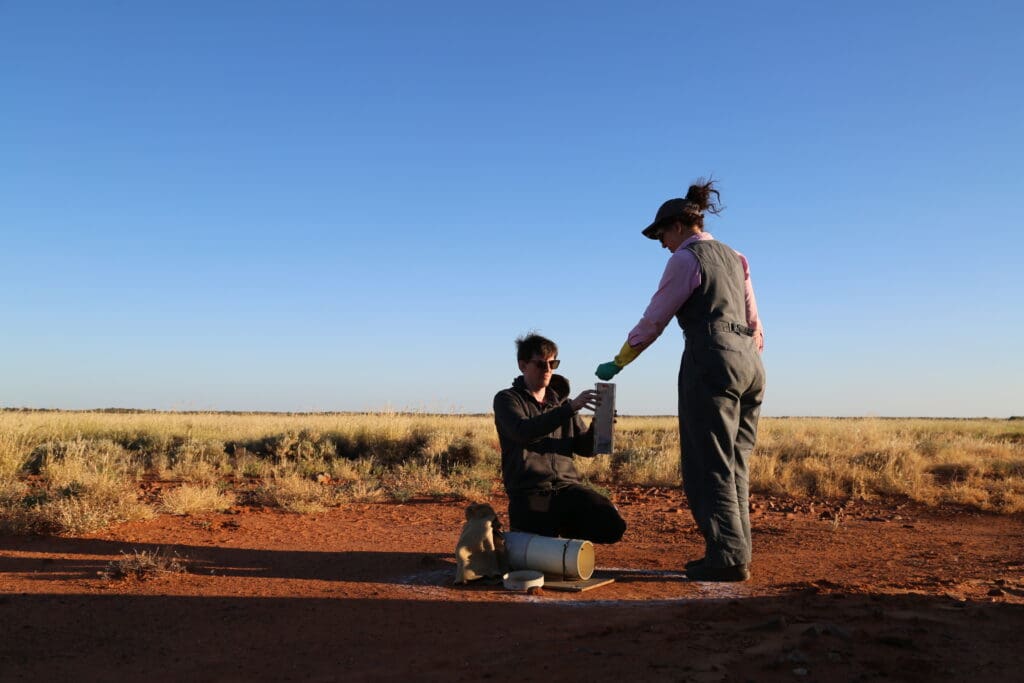
The teams are a mix of kowari enthusiasts: Arid Recovery’s Ecologists and two Conservation Interns, an Adelaide University PhD student, five Kokatha Rangers, and a kowari advocate who has ridden her bike across the Simpson Desert raising money for the species: Kirstin – plus her five-year-old son Otto.
The task at hand appears simple: set 186 traps across an 80km2 area, bait with dog biscuits soaked in tuna oil and kangaroo mince, insulate the traps from the desert cold with wool and hessian sacks, and check the next morning for any critters that may have gone in. Then repeat the following night.
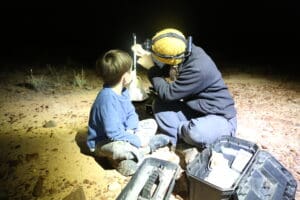
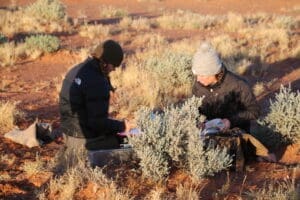
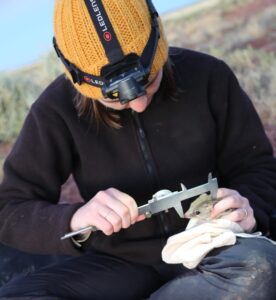
It’s 6:30am in the ‘Red Lake Team.’ One of the Kokatha Rangers jumps out to check a closed trap. She gently opens the door a crack and peers inside. ‘KOWARI,’ she calls back to the car. The car is turned off, and the team jumps out like a well-oiled machine. Someone grabs a calico bag, someone grabs the datasheet and pen, someone grabs the processing kit.
The calico bag is attached to the end of the Elliott trap, and the kowari gently tipped into the bag. Hanging scales are used to weigh the animal – 92 grams. A small microchip is inserted into the back of its neck so if the individual is caught in future surveys, the team will be able to identify it again. The sex is checked – female, non-breeding. Her body condition is recorded – good condition. Particularly fluffy like they often are in winter. Vernier calipers are used to measure her foot and head length. A DNA sample is snipped from the outer edge of her ear for future genetic analysis. Once all information has been collected, she is released from the bag. The team uses their headtorches to watch her run away into the darkness, darting this way and that, stopping at one point to turn around, one foot held off the ground, reorienting herself in her surroundings before she identifies the way back to her burrow, zooming back in a straight line.
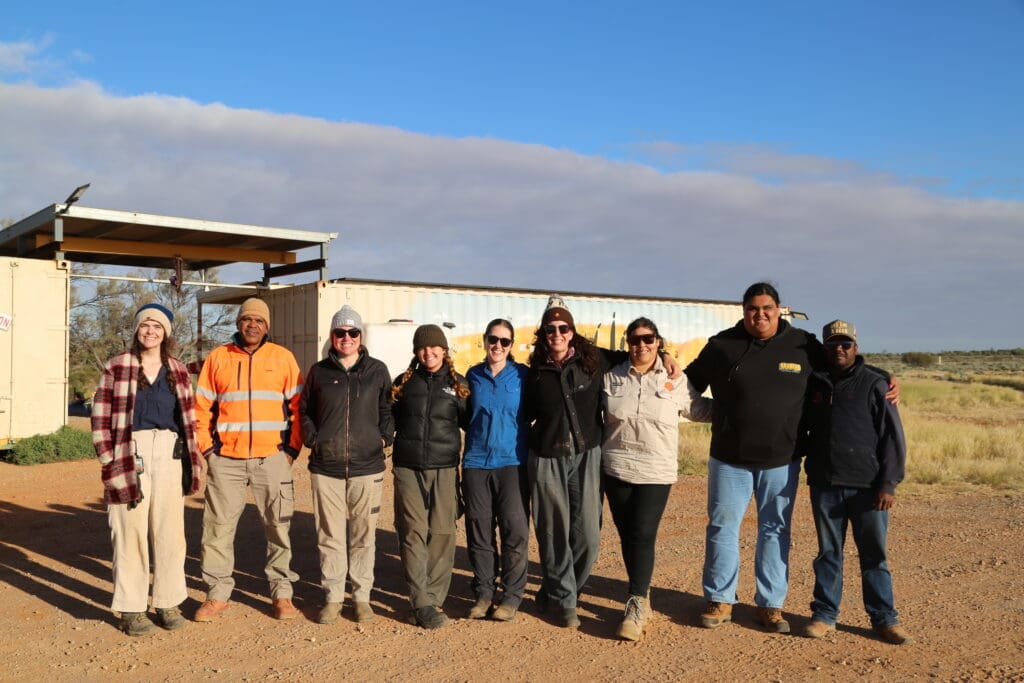
It’s 8:00m on that same Wednesday morning. All traps have been checked, and the teams are back at the research station. Captures were added to the weekly tally – two kowaris from the Red Lake Team and one from the Northern Team, making a grand total of seven so far. A rouge western quoll in one trap too. For the rest of the day the teams take it easy. Breakfast, shower, data entry, maybe a nap or some birdwatching. Before reopening traps in the late afternoon, ready to do it again Thursday morning. Three mornings down, two to go…..
Photo credits: Kirstin Isaacs